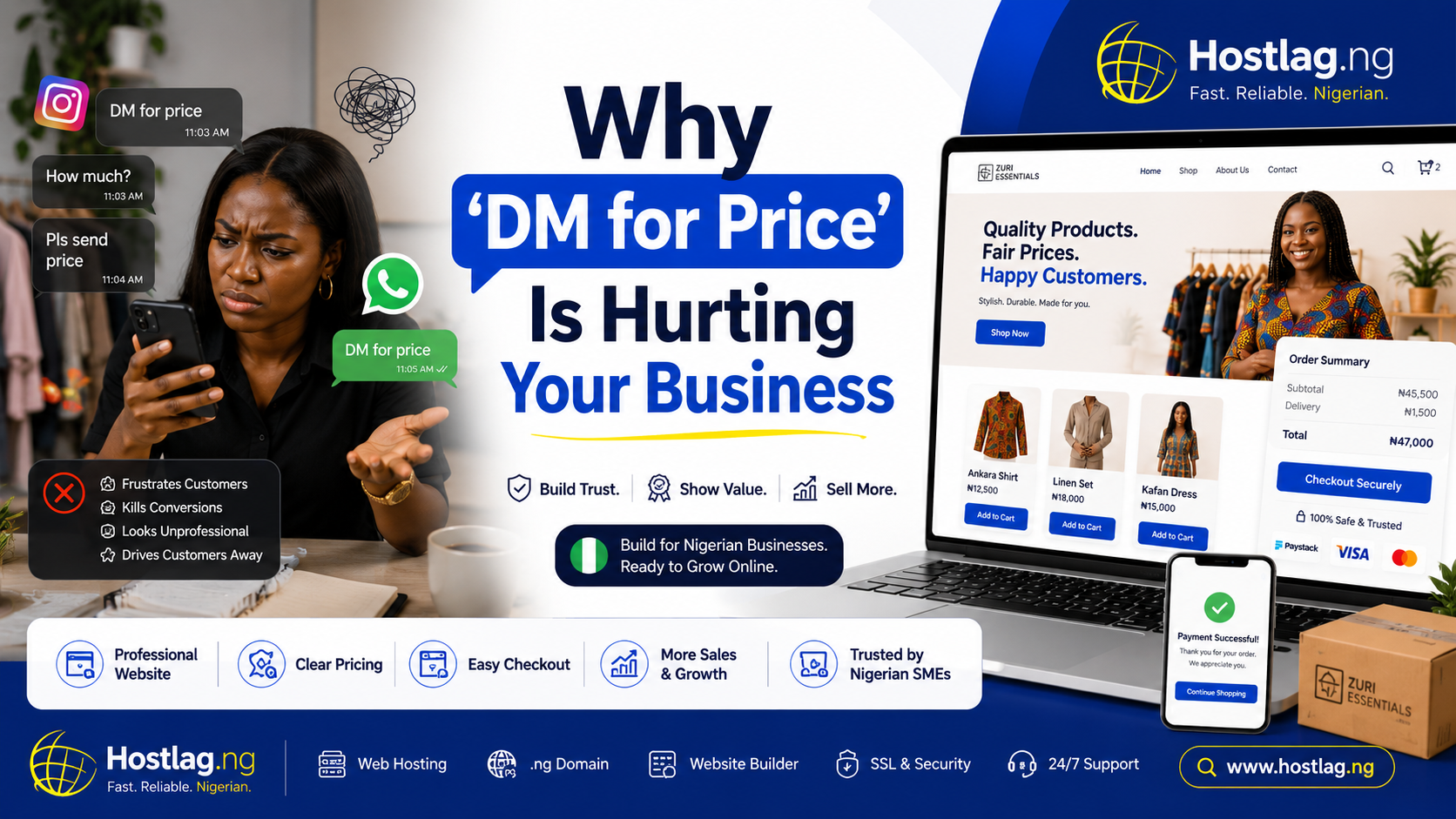
Spend a few minutes scrolling through Instagram, TikTok, Facebook Marketplace, or WhatsApp Status, and you’ll spot it everywhere:
“DM for price.”
It’s become almost a default move for online sellers. Some do it to keep competitors in the dark about their pricing. Others think it boosts engagement. Many just go along because, well, everyone else seems to be doing it.
But here’s the uncomfortable truth:
Not because your product isn’t great. Not because they can’t afford it. But because modern customers can’t stand unnecessary hassle.
And in a crowded online market, even a little bit of stress can send them straight to your competition.
If you’re serious about moving beyond random social media sales—and building a real online business—it’s time to rethink this habit.
When someone lands on your page, they instantly want to know:
How much is it?
Is it available?
How do I order?
How long will delivery take?
Where are you located?
If you force them to send a message just to find out the basics, you’re making their life harder.
And making things harder means fewer sales.
Picture this:
Imagine walking into a supermarket where nothing has a price tag. You have to hunt down a staff member and ask for the price of every single item.
Stressful, right?
That’s exactly how “DM for price” feels to many online shoppers.
A big myth among sellers is thinking, “If they’re interested, they’ll message me.”
But the truth? Most won’t.
Many buyers just leave your page quietly—and never come back.
Why? Because social media has trained us all to move fast. Attention spans are short. If someone can’t get the info they need right away, they’ll just scroll on.
Chances are, the next seller they see will have:
Clear product pricing
An organized online catalog
Simple checkout options
Delivery details up front
The seller who makes things easier usually wins—not always because they have better products, but because they offer a smoother experience.
These days, convenience is part of your marketing.
When customers can’t see your prices, their minds start racing:
“Maybe the price changes depending on who asks.”
“Maybe it’s expensive.”
“Maybe they’re not organised.”
“Maybe this isn’t a real business.”
Even if none of this is true, those doubts can cost you the sale.
People trust businesses that are open and structured.
When you show your prices, you look professional.
When you hide them, you add uncertainty.
And uncertainty slows things down—especially when you’re just starting out and trying to build trust.
With scams and fake vendors everywhere, buyers are cautious. If your business feels unclear, plenty of people will just avoid the risk.
Impulse purchases are a huge part of online sales.
Someone spots something they love and buys it on the spot.
But that only happens when buying is fast.
If a shopper has to:
Send a DM
Wait for a reply
Ask extra questions
Negotiate back and forth.
…the excitement fades.
And when excitement fades, so do sales.
Showing the price helps people say “yes” in the moment.
Hiding it slows them down.
That tiny delay can add up to a lot of lost sales over time.
There’s nothing wrong with selling via WhatsApp or Instagram.
Social media is amazing for:
Getting seen
Marketing your products
Engaging your audience
Building community
Chatting with customers
But DMs aren’t meant to handle your entire sales process.
Relying only on messages creates problems:
Conversations get buried or lost.
Orders are hard to track
You answer the same questions over and over.
Manual replies eat up your time.
Scaling up becomes almost impossible.
At first, it might feel doable.
But as you grow, things get messy.
Many business owners eventually realise they’re spending more time responding to messages than actually building their business.
That’s when you know: it’s time for a better system.
One of the biggest differences between a casual online vendor and a real digital business? Structure.
A real website changes how people see you.
It tells customers:
This business is organised.
Products and prices are clear.
Ordering is simple
Payments are professional
The brand is trustworthy.
Instead of pushing people into endless chats, a website lets shoppers browse, decide, and buy—on their own time.
They can:
See products anytime
Check prices instantly
Read details and descriptions.
Place orders directly
Contact you only if they need to
That kind of convenience boosts trust and sales.
And unlike social posts that disappear, a website gives your business a permanent home online.
Sooner or later, most online sellers realise social media alone isn’t enough to build a lasting business.
Algorithms change.
Accounts get restricted.
Posts lose reach.
Your inbox gets overwhelming.
That’s why smart business owners are investing in platforms they control—especially websites.
A website gives you:
Credibility
Stronger branding
Google search visibility
A central product catalog
Easier customer management
Professional payment systems
Most of all, it makes your business look established.
That’s why platforms like Hostlag.ng are so valuable for modern businesses.
Instead of relying on DMs, you can build a real online presence—with everything from domains and hosting to user-friendly website solutions that help you look professional from day one.
For many small businesses, this step is the difference between “just selling online” and building a real, scalable brand.
Sellers often don’t realise how much time goes into repeating the same info every day.
How many times do you answer:
“Price?”
“Is it available?”
“Where are you based?”
“Delivery cost?”
“How to order?”
“Can I see more photos?”
Multiply that by dozens of customers a week—it adds up fast.
An online store answers these questions for you automatically.
That frees you up to focus on:
Sourcing great products
Marketing
Keeping customers happy
Creating content
Growing your business
When your store handles the basics, you finally get time to work on what actually moves your business forward.
The internet rewards simplicity.
The businesses winning today are the ones that make buying easy—not complicated.
People want:
Fast answers
Clear prices
Smooth ordering
Professional branding
Zero stress
The easier you make things, the more people trust you.
That’s why successful businesses eventually move past “DM to order” and invest in proper systems.
Because real growth demands structure.
There are situations where private pricing makes sense, like:
Custom services
Luxury products with variable rates
Wholesale deals
Bulk orders
Complex projects needing consultation
But for standard, fixed-price products?
Hiding prices usually backfires.
Most customers just want things to be clear and simple.
And businesses that offer clarity almost always sell more.
Why do businesses hide prices online?
Mostly to avoid competitors copying them, encourage more engagement, or leave room for negotiating. But honestly, this usually frustrates customers and costs you sales.
Does showing prices mean fewer DMs?
Yes—and that’s actually a good thing! You’ll filter out people who aren’t serious, and attract more buyers who already like your price.
Can I still sell well on WhatsApp and Instagram?
Absolutely. Social media is a powerful sales tool. The key is not to rely only on DMs—structure the buying experience so it’s easier for you and your customers.
Why is having a website so important?
A website boosts trust, makes your business look organised and professional, improves your visibility, and helps customers shop more easily.
What’s the biggest problem with “DM for price”?
It adds friction. Every extra step makes it less likely someone will actually buy from you.
Customers have endless options, short attention spans, and high standards.
If buying from you feels stressful, confusing, or slow, they’ll leave—sometimes without saying a word.
“DM for price” might seem harmless, but it creates barriers between you and your customers.
Modern buyers want things to be easy, open, and fast.
And the businesses that deliver on those things are the ones that win.
Social media is a great way for people to find you.
But real growth?
That happens when you move beyond chats and DMs—into a structured online presence people can trust, navigate, and buy from with confidence.
Ready to make that shift?
Platforms like Hostlag.ng are making it easier than ever for businesses to move from “selling in DMs” to building a real online brand with a lasting digital footprint. Thinking about making the switch, but not sure what it actually takes—or what it might cost? In our next article, “What You Need to Get Online in 2026 (and How Much It Really Costs),” we’ll break down exactly what you need (domain, hosting, website platform) and give you up-to-date pricing so you can plan with confidence.